Why homeowners ask about phasing
If you’re thinking about phasing a landscape project, that’s normal.
Most homeowners ask about it for practical reasons. Sometimes it’s the budget. Sometimes it’s timing. Sometimes it’s simply wanting to get started without committing to everything all at once.
We also see people ask about phasing because they’re being careful. They don’t want to rush into a big decision. They want to understand their options. They want to make sure the space works for how they actually live.
Where things start to get confusing isn’t the question itself. It’s how phasing is often explained. Online, it’s usually presented as a low-risk way to make large projects easier. In real landscape construction, it doesn’t always work that way.
This guide isn’t meant to talk you out of phasing. It’s meant to explain how phasing actually plays out on real properties, so you can decide if it’s the right approach for your space.
What “phasing” really means in landscape construction
In landscape construction, phasing has a specific meaning.
When phasing is done properly, the entire yard is planned from the start. The difference is timing. Some parts are built now. Other parts are built later.
Each phase needs to work on its own. It should feel usable and complete. Most importantly, it should not need to be taken apart later to make room for the next phase.
Phasing is not designing as you go, building random pieces without a long-term plan, avoiding hard decisions, or a guaranteed way to reduce cost.
Delaying a decision doesn’t remove it. In construction, decisions that aren’t made early often get made for you later through access limits or structural requirements.
Two simple questions that shape every phased project
Almost every phased landscape project comes down to two practical questions.
Will future work need access through finished areas? Once patios, pools, fences, or structures are built, access can disappear quickly. Rework usually adds cost and disruption.
Does one part of the project depend on another? Retaining walls affect grades. Grades affect patios. Patios affect drainage. Overhead structures rely on footings that interact with finished surfaces.
Most challenges with phasing come back to access and dependency.
Where phasing tends to work more smoothly
Phasing often works better when different areas of a property are clearly separated.
Front-yard and backyard projects can often be completed in different seasons with minimal overlap.
Large or rural properties usually allow easier access for future work.
Planting is often phased successfully once grading and hardscape are complete.
Lighting can be phased if conduit and sleeves are installed early.
Furniture and non-structural features are naturally easy to add later.
Situations where phasing often becomes more complex
Retaining walls, patios, and grade changes typically function as a single system. Separating them can leave awkward slopes or require rework later.
Overhead structures require footings that interact with finished surfaces. Concrete footings or helical piles often require installation before the concrete is poured.
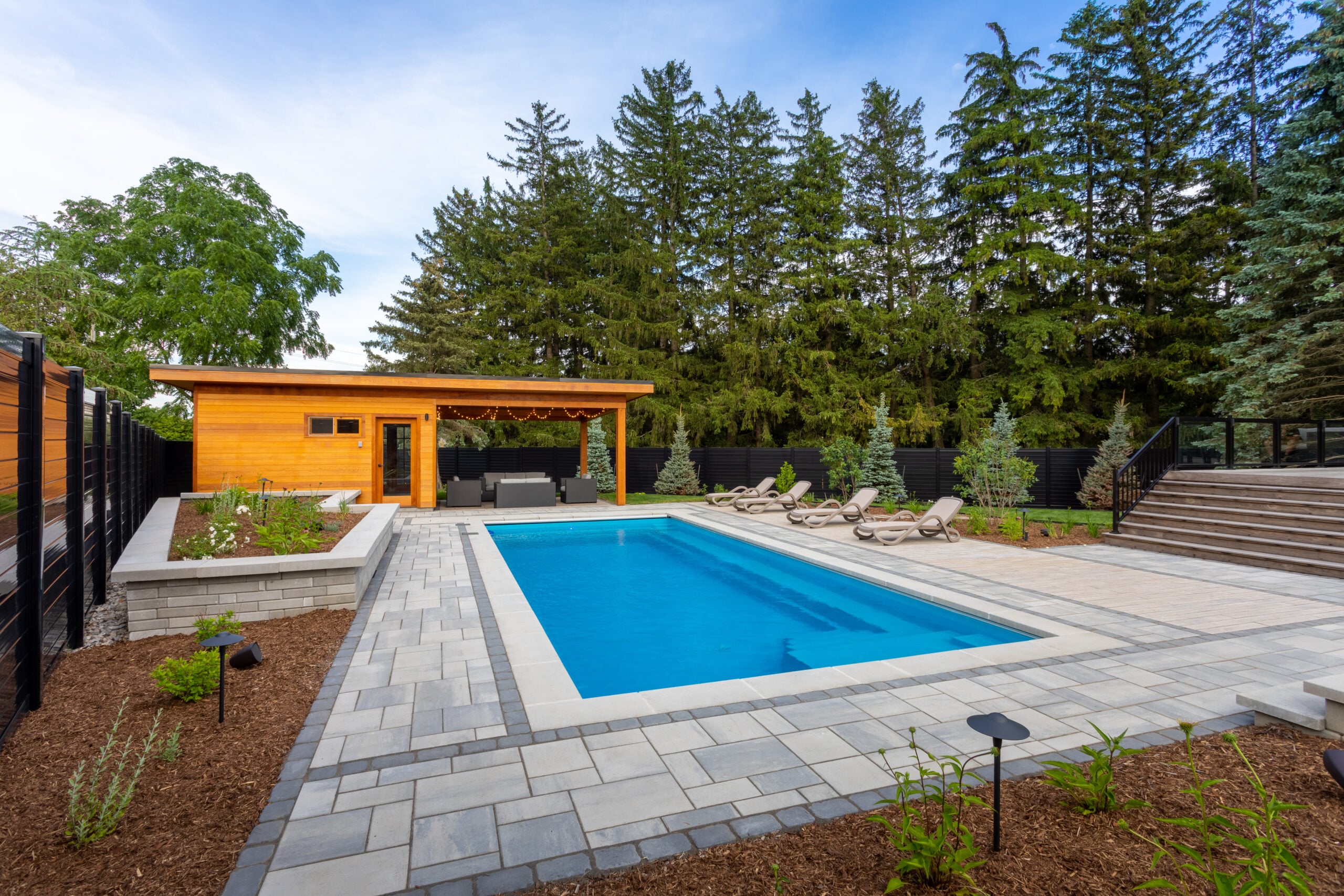
On tight subdivision lots, future access can disappear once pools or patios are installed.
Temporary solutions, such as grass where a patio is planned, often last longer than expected and lead to rework later.
Cost, scheduling, and the construction season
In Canada, the outdoor construction season is short. Crews and equipment are scheduled carefully.
Smaller standalone phases are harder to schedule efficiently than work bundled into a larger project.
Minimum charges or premiums often reflect the realities of mobilizing crews during a limited season, not the complexity of the task itself.
Understanding the trade-offs
Phased projects often cost more overall, take longer to complete, and involve living with unfinished or temporary areas.
Scheduling is often based on availability rather than preference.
These are not mistakes, but realities that are easier to manage when understood early.
How to approach phasing thoughtfully
Start with a complete master plan.
Identify what cannot be accessed later.
Be honest about what will look unfinished.
Understand where costs and timelines may shift.
The real choices homeowners face
Most projects come down to three paths: build everything at once, redesign to reduce dependencies, or phase the project with clear expectations.
The most important thing is choosing knowingly.
Considering a phased landscape project in Southern Ontario?
Every property is different. Access, grading, and layout all affect how phasing works.
We regularly work with homeowners in Flamborough, Ancaster, Dundas, Cambridge, Kitchener, Waterloo, Guelph, and surrounding townships.
Early planning can help avoid frustration and unnecessary costs later.
Final thoughts
Phasing a landscape project is often a thoughtful question, not a mistake.
Outdoor spaces are built systems where access and sequencing matter.
Clarity early on helps protect your investment, whether you build all at once or in phases.